
Book Tour!
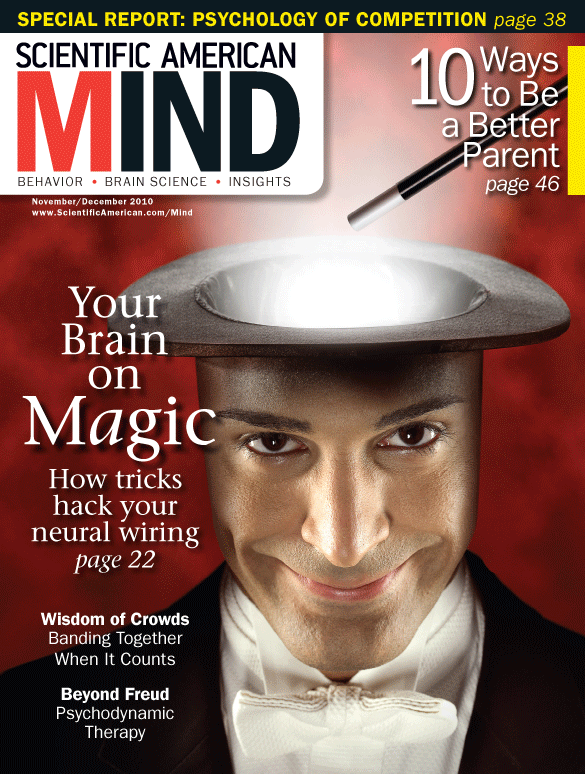
Our book tour has launched! We signed copies of sleights of mind in the worth publishers booth at the society for neuroscience’s annual conference in San Diego last monday-Tuesday. On Thursday night, we were at the new York academy of sciences, for a joint presentation with James (aka the amaz!ng) randy, skeptic extraordinaire and founder of the one million dollar paranormal challenge, for anybody who can demonstrate psychic abilities in a controlled environment. Randi spoke about the dangers of making unfounded assumptions, both as spectators of magic shows and in life. Some of randi’s recent endeavors include debunking claims from homeopathic medicine. I highly recommend watching randi’s Ted lecture of 200?, in which he swallowed a “lethal” dose of homeopathic sleep pills onstage. A great stunt, here is the link: http://www.ted.com/talks/james_randi.html


7 Comments
I have just read this excellent book and recommend it to all. Thank you!
One small cavil: on page 235 there is a reference to George Smiley who is referenced in an asterisked note as “the main character in John le Carre’s novel ‘The Spy Who Came In from the Cold.’” However, although Smiley does appear in the book, the main character is named Leamas. Smiley is the protagonist in the eponymous novel and its sequels.
Thank you Jerome, for both the kind words and the kind correction! We will fix the problem for our paperback edition.
I just finished reading this wonderful, wonderful book. I came to this website to suggest that you make a book tour stop in Seattle. But, then, I see that you’ve already done that. Arg. How did I miss that? Was it great enough that you’d consider coming back?
HI,
Great book ! Brilliant idea you stated near the end – something like this : ” We are a narrative, written by the victors – the victors in our evolutionary past, in our senses and mind and in our environment” Could you please give me the exact quote – I would like to use it in my talk on the philosophy of science “Reality and Illusion” when I discuss both the fallible narrator and Francis Bacon’s “Idols of the Marketplace” for it is the victors in the Marketplace of ideas that write much of our narrative for us.
Since I listened to the book on audible it is hard for me to look up.
Thank you for the excellent book!
Greg Hunter
Hi
Did you get my comment on your fine idea:
“Our self is an narrative, written by the victors” – and speaking of neuro science – I remember exactly where I was biking when I heard that on my audible book – interesting I often remember where I was when I heard something on my MP3 player – too bad I can’t remember your exact quote – could you give it to me again – I would like to use it in a talk – in which I was already using this quote of Churchill’s “History will be kind to me as I intend to write it”
Also I was very interested in your idea that our subconcious is quite unaccessible to us – I have noticed a time that it becomes accessible – when I can’t remember someone – I can remember how my subconcious feels about that person – ususally I agree there is some or quite a bit of truth in it – sometimes I disagree a bit. An interesting question is how current is our subconcious compared to our concious as our opinions change.
thanks for the great book
Greg Hunter
oops sorry I see my comments are being assessed
please change unaccessible to inaccessible in by comment
thanks
Greg
Just finished reading your book. It was neat to see you guys mention capoeira. However, it’s too bad you guys only referenced it in relation to skills empathy and mirror neurons. There’s a lot of depth to capoeira that involves what the Brazilians call “malandragem.” The Afro-Brazilian slaves developed this form of martial art while disguising it as a dance. As it’s played today, the movements are disguised and misdirection is heavily employed. It’s great to learn why some of these tactics work neurologically.
Also, I’ve recently come to conclude that what most people describe as “irrational” choices can be better described as misinformed choices. It was good to see that briefly mentioned at the end of the book.